
At a Glance
Key Insight
Governance fails when it is built for control instead of clarity. Effective governance protects the enterprise while enabling teams to deliver faster, with higher decision quality and lower risk.
Strategic Takeaways
- Tech governance must operate as a decision system that increases clarity, reduces risk, and accelerates delivery across the entire organization
- Governance must be designed as a decision system, not a compliance ritual
- Decision rights, standards, forums, and automation form the core governance stack
- Risk‑tiered governance balances speed and control without slowing delivery
- Governance quality is measurable and should be continuously improved
Target Audience
CEO, Founder, CTO, CPO, CIO, COO, Board Members, Transformation Leaders
Problem Statement
Most governance models are slow, bureaucratic and disconnected from real delivery. Teams experience governance as a blocker, not an enabler: leading to shadow decisions, inconsistent standards and unmanaged risk.
Solution Summary
A modern governance model is lightweight, risk‑based and embedded into delivery workflows. It clarifies decision rights, simplifies standards, accelerates decisions and uses automation to reduce friction. Governance becomes a strategic capability, not a constraint.
Interested in exploring how this approach can benefit your organization? Let's discuss your specific challenges and opportunities in an advisory call.
Insight
Why Governance Gets Rejected
Most organizations have governance. Few have governance that works.
The gap between the two is rarely about intent. It’s about timing and design. Review boards enter the picture after key decisions have already been made. Policies are written for auditors, not practitioners. Documentation becomes a ritual: boxes checked, risk unchallenged.
The consequences follow a familiar pattern. Teams learn to route around the process. Architectural decisions get made in backchannel conversations. Data handling diverges across business units. Security considerations surface only when something goes wrong. Accountability, when it’s needed most, belongs to no one.
What strikes me, across the organizations I’ve worked with, is how rarely this is a failure of compliance. I think that’s most a failure of relevance. Governance that arrives late, speaks abstractly and adds friction without adding judgment doesn’t get rejected out of malice it gets rejected because it doesn’t fit where the work actually happens.
The result is a structure that exists on paper and governs almost nothing in practice. Risk doesn’t disappear when governance is bypassed. It accumulates, quietly, across systems and decisions, until the cost of ignoring it becomes impossible to defer.
This is the foundational problem. And it’s worth naming clearly before proposing any solution: governance fails not because organizations resist oversight, but because the oversight they have was never designed to work.

“Governance fails when it is experienced as a blocker rather than a decision accelerator.”
Method
Principles of Practical Governance
Governance doesn’t fail because organizations lack rules. It fails because the rules lack structure: NO shared understanding of what requires oversight, NO calibration to actual risk, NO alignment with how decisions get made in practice.
Over the years, I’ve distilled effective governance to four principles. Not frameworks. Not maturity models. I think principles could be different across industries, team sizes and technology generations but some of them are, from my point of view, a good starting point in every scenario.
Clarity. People bypass governance when they’re uncertain whether it applies to them. Effective governance removes that ambiguity. It defines, explicitly and accessibly, which decisions require oversight and why. When the boundaries are clear, the process gets used.
Proportionality. Not every decision carries the same weight. A governance model that treats a minor configuration change with the same rigor as a core architectural decision trains people to ignore it. Controls should scale with consequence: lighter where stakes are low, more rigorous where they’re not.
Timeliness. This is where most governance models fail operationally. If review cycles can’t match the pace of delivery, teams will make decisions without them: not out of defiance, but out of necessity. Governance that arrives after the fact doesn’t prevent risk. It documents it.
Traceability. Decisions without a record are decisions that can’t be learned from, challenged or defended. Traceability isn’t about surveillance, it’s about accountability and institutional memory. Who decided, on what basis and what happened as a result.
Taken together, these principles do something important: they reframe governance from a control function into a decision-making infrastructure. The goal isn’t oversight for its own sake. It’s making sure the right judgment gets applied, at the right moment, by the right people.
That shift in purpose changes everything about how governance is designed: and, moreover, whether it gets used.

“Clarity and proportionality turn governance from bureaucracy into leverage.”
Framework
The Governance Stack
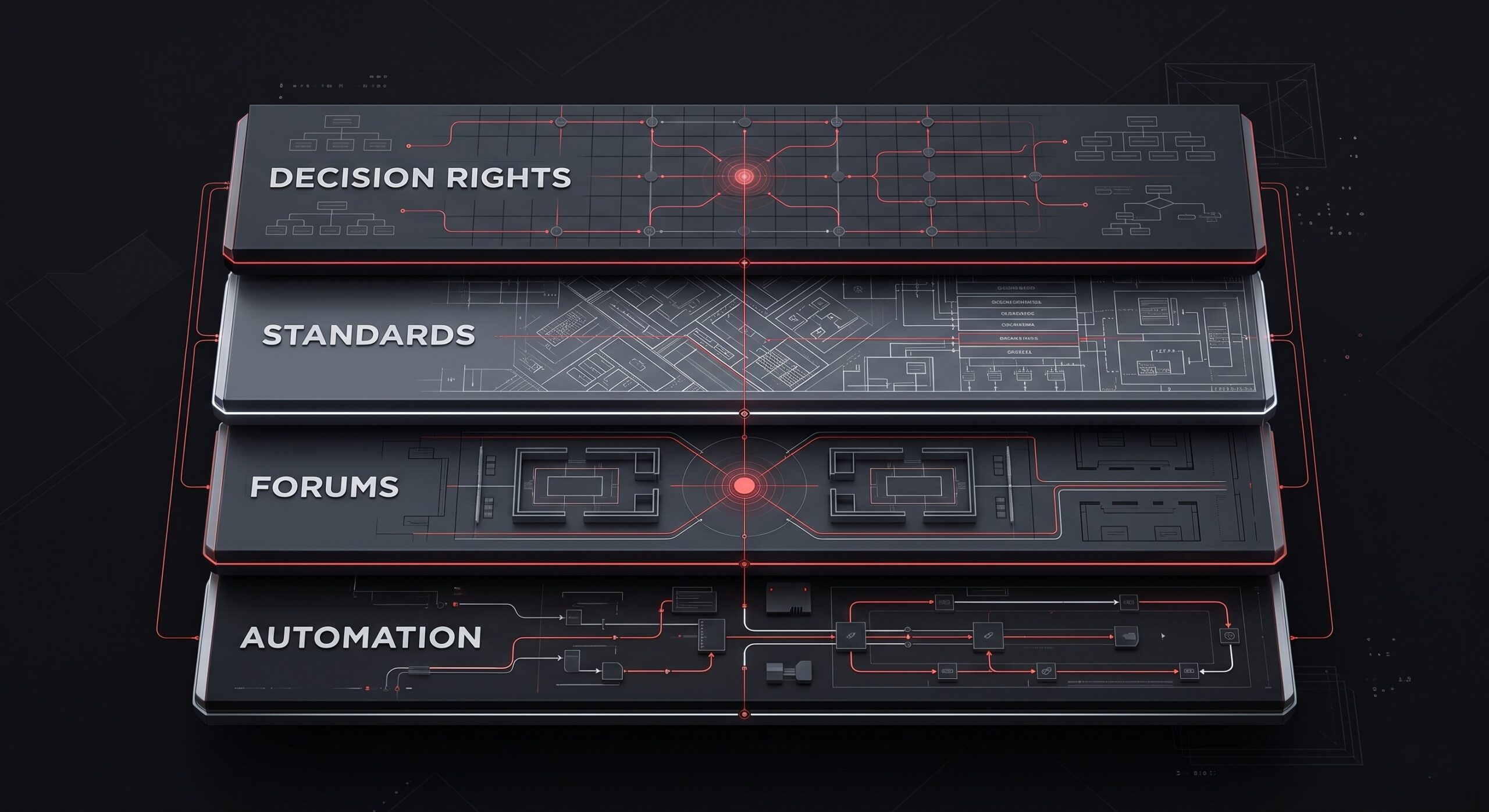
Principles define intent. Structure makes them operational. In practice, effective governance runs across four distinct layers: each with a different function, each dependent on the others working well.
Decision Rights: The first question governance must answer isn’t what gets reviewed but it’s who decides. Across product, engineering, architecture, security and finance, ambiguity about ownership is one of the most expensive problems I see in large programs. It rarely looks like chaos. It looks like slow escalations, duplicated effort and decisions made by whoever had the last meeting. Defining decision rights explicitly, and publishing them, eliminates a category of friction that most organizations have simply learned to tolerate.
Policies and Standards: Standards fail when they’re written to be comprehensive rather than usable. The test I apply is simple: can this standard be acted on during delivery, by the team doing the work? If not, it will be ignored or worked around. Keep policies concise. Draw a clear line between mandatory controls and recommended patterns. When a standard can’t survive contact with practice, the answer is to rewrite it, not to enforce it harder.
Forums and Cadence: Governance lives or dies in how decisions actually get made week to week. The most common mistake is consolidating oversight into infrequent, broad reviews; monthly slide decks that surface risk too late to act on. What works is the opposite: targeted forums, focused agendas, regular cadence. A weekly risk and decision rhythm creates accountability and keeps issues from aging into crises.
Tooling and Automation: Controls that depend entirely on human discipline will drift. Embedding automated checks (for security posture, dependency risk, policy compliance) into engineering workflows removes the friction of manual governance and raises the floor on consistency. The goal isn’t to replace judgment; it’s to reserve human judgment for decisions that actually require it.
These four layers don’t operate in sequence. They reinforce each other. Weak decision rights undermine forums. Unenforceable standards erode trust in the stack as a whole. When they’re aligned, governance stops feeling like overhead and starts functioning as infrastructure.
“Governance works when it is embedded, not imposed.”
Method
How to Balance Control and Speed
The tension between governance and delivery speed is real: based on my experience it’s largely a design problem, not an inherent conflict. Most organizations apply the same level of scrutiny to everything, which means they’re simultaneously over-governing routine work and under-governing decisions that actually carry consequence. The overhead accumulates. Teams grow impatient. Governance gets bypassed.
The mechanism I return to most consistently is risk-tiered governance. The logic is straightforward: match the weight of the control to the weight of the decision.
- Tier 1 — Low Risk. Routine changes, well-understood patterns, limited blast radius. Governance here should be nearly invisible: automated checks, local team approval, no escalation required. If a team has to wait for a review board to deploy a minor configuration update, something is wrong with the model.
- Tier 2 — Medium Risk. Changes that touch shared infrastructure, introduce new dependencies or have cross-functional implications. A lightweight architecture or security review is warranted: focused, time-bounded, and staffed by people who can actually evaluate the decision. The goal is a second perspective, not a procedural hurdle.
- Tier 3 — High Risk. Decisions with material consequences: significant architectural shifts, new data obligations, regulatory exposure, major vendor commitments. These warrant executive-level governance, explicit risk acceptance, and documented rationale. The scrutiny should be proportional to what’s at stake: it’ll be rigorous, not performative.
What makes this model work is that it forces an organization to think clearly about risk before defaulting to process. Most decisions are Tier 1. A meaningful minority are Tier 2. Tier 3 should be rare and when it isn’t, that’s a signal worth examining in its own right.
Speed and control aren’t opposites. They’re calibration problems. Get the tiers right and governance becomes something delivery teams can work with rather than work around.

“Speed without control is chaos. Control without speed is stagnation.”
Insight
Common Anti‑Patterns & Metrics That Matter
Good governance design requires knowing what failure looks like: not in theory, but in the specific, recognizable patterns that accumulate quietly until they’re too costly to ignore.
The anti-patterns I see most often:
Committee overload. When too many stakeholders hold review rights, decisions stall. Accountability diffuses. The governance body becomes a coordination problem in its own right and teams learn to route around it.
Policy sprawl. Standards multiply faster than they’re retired. Over time, the policy library becomes a body of contradictions no one has the authority to simplify. Compliance becomes performative because full compliance is practically impossible.
Late-stage reviews. Governance inserted at the end of a delivery cycle doesn’t prevent risk: it just makes it visible at the worst possible moment, when the cost of change is highest and the appetite for it is lowest.
No feedback loop. Governance without measurement is governance on faith. When decisions are made but outcomes are never tracked, the model can’t improve. The same failure modes recur and no one has the data to explain why.
These patterns share a common thread: governance has drifted from its purpose. The correction isn’t more process: it’s better signal.
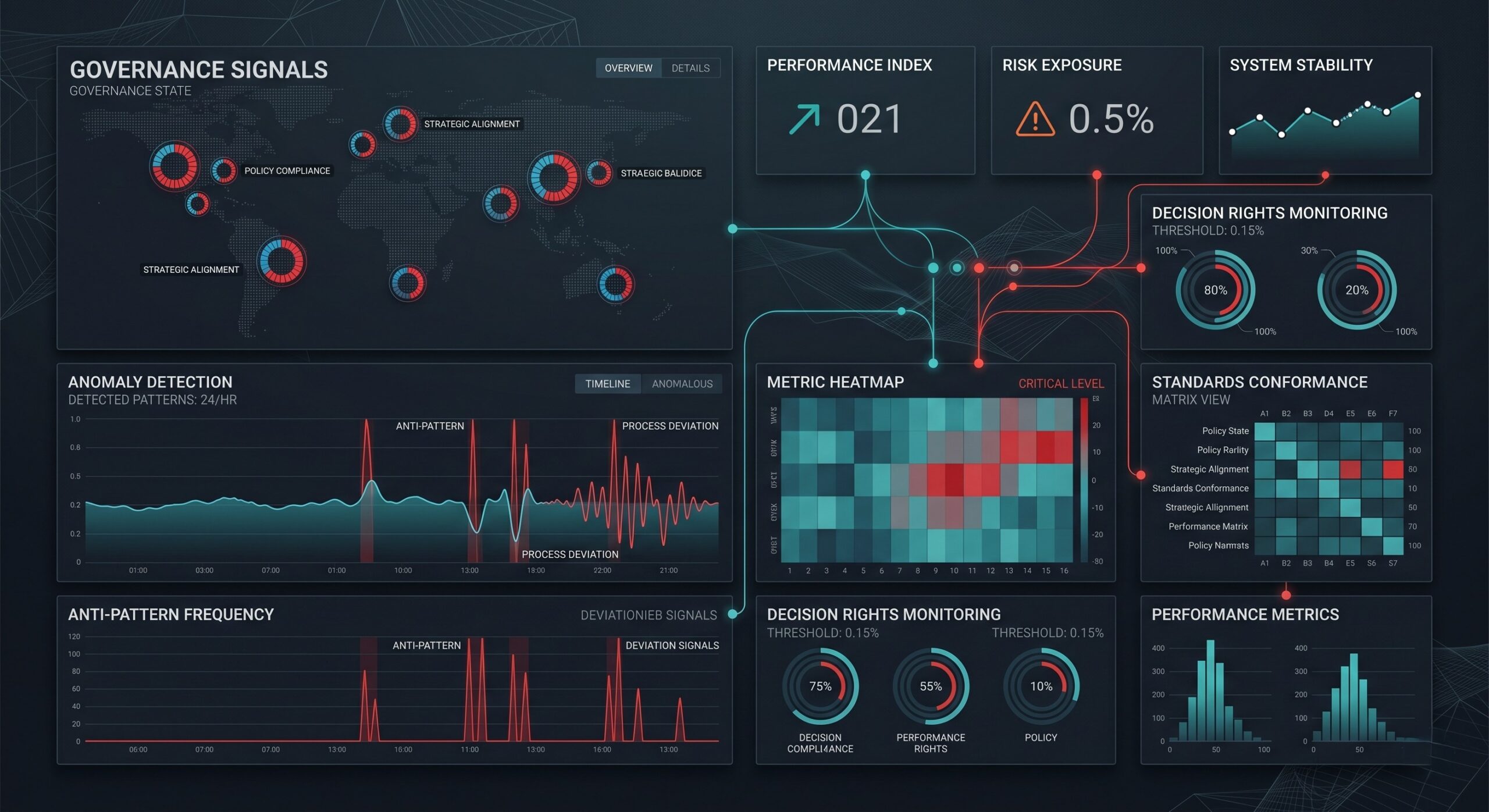
The metrics I consider meaningful:
- Decision turnaround time measures whether governance is operating at the pace of delivery or acting as a bottleneck
- Percentage of automated controls reflects how much oversight is embedded versus dependent on manual discipline
- Incidents linked to non-compliance connects governance gaps directly to outcomes: I think this is the most honest measure of whether controls are working
- Exception volume and closure time reveals where the model is either too rigid to fit real work or where accepted risk is accumulating without resolution.
Measured consistently, these four indicators give leadership an honest picture of governance health: not activity, but function. The goal isn’t a perfect score. It’s a system that learns.
“What gets measured improves, governance included.”